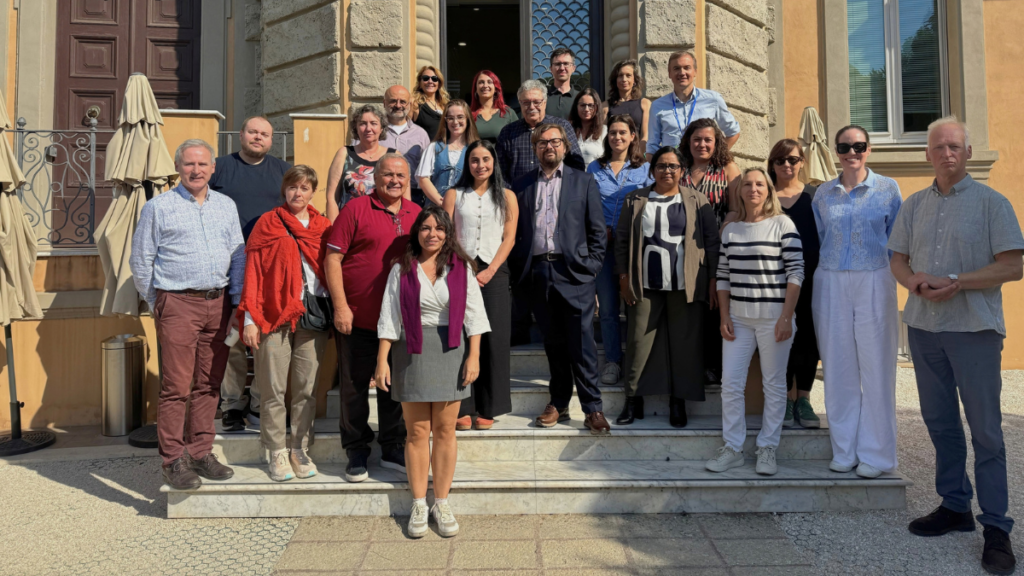
On Friday 2 October 2026, the BIOSPARK consortium met in Rome for the project’s kick-off meeting, hosted by Unitelma Sapienza. The meeting, one day after the official start on 1 October, launched a 30-month initiative funded by the Circular Bio-based Europe Joint Undertaking (CBE JU) under Horizon Europe.
BIOSPARK (Skills Promotion and Awareness for Regenerative Knowledge) is coordinated by Merve Atasoy of the University of Eastern Finland (UEF). It brings together 18 partners from 11 European countries, including universities, research and technology organisations, industry representatives and communication specialists. Their shared aim is to strengthen education, training and lifelong learning for Europe’s circular bioeconomy.
Why BIOSPARK matters
Europe’s move to a sustainable and circular economy is increasing the demand for professionals with specialised bioeconomy skills. Technology in the sector has advanced quickly, but education and training have not kept pace. Training frameworks are fragmented, skilled professionals are in short supply, widening countries are often left out, and universities and industry still collaborate too little. BIOSPARK was designed to address these gaps directly.
Building on BIObec: a network of 27 Bio-Based Education Centres
BIOSPARK builds on the legacy of the BIObec project, as well as the European Bioeconomy University Alliance and the BIOEAST University Network. At the heart of the project is a pan-European network of 27 Bio-Based Education Centres (BBECs), one in each EU Member State. The network will help build the bioeconomy workforce of today and tomorrow.
Through this network, education and training providers, research organisations, businesses and regional stakeholders will co-design and pilot new curricula, micro-credentials and lifelong learning opportunities. They are meant for three groups: university students, vocational education and training learners, and professionals who want to upskill or reskill. The project pays particular attention to widening countries and to regions with less advanced research and innovation capacity. The aim is for high-quality bioeconomy education to be available across Europe, wherever learners live.
A day of joint work in Rome
The kick-off meeting was the consortium’s first chance to work together face to face. Partners reviewed the project’s objectives and the role of each work package. They agreed on priorities for the first months and discussed how to set up the European network of Bio-Based Education Centres. CBE JU Project Officer Simone Maccaferri also joined the meeting and gave partners useful guidance as the project gets underway.
Looking ahead
The partners left Rome with a shared plan and a common goal: a more skilled, sustainable and resilient European bioeconomy. Over the coming months, BIOSPARK will begin engaging students, educators, researchers, businesses and policymakers. It will share progress, educational resources and ways to get involved along the way.
BIOSPARK is also a member of the European Bioeconomy Network (EuBioNet). Membership links the project with a wide community of EU-funded bioeconomy initiatives.
Follow the project on LinkedIn and X, or contact us at info@biosparkproject.eu