Connecting research, education and everyday life
How can education bring the circular bioeconomy to life in classrooms, workplaces and communities? This question brought together educators, researchers and practitioners at University College Dublin (UCD), Ireland, on 19 October 2026, for the workshop “Embedding Bioeconomy in Education Programmes”, a satellite event of the Global Bioeconomy Summit (GBS) 2026.
The event explored how education can connect scientific knowledge with real-life experiences, support educators and equip learners with the skills and understanding needed to actively contribute to the circular bioeconomy.
The programme combined research site visits, expert presentations and interactive discussions. Participants explored microalgae cultivation, mushroom production and innovative approaches to converting campus food waste into compost. These activities demonstrated how circular bioeconomy principles can be translated into practical applications and connected to everyday experiences.
The afternoon sessions brought together contributions from several initiatives working to strengthen bioeconomy education in Ireland and internationally, including Generation Glas, BioBeo, the Bioeconomy Education and Sustainability Teachers Network (BEST), and the Circular Bioeconomy Education Centre (CBEC).
Discussions addressed key challenges, including teacher confidence, fragmented educational resources and the need to connect curriculum development with workforce skills and lifelong learning.
BIOSPARK: Connecting education, industry and regions
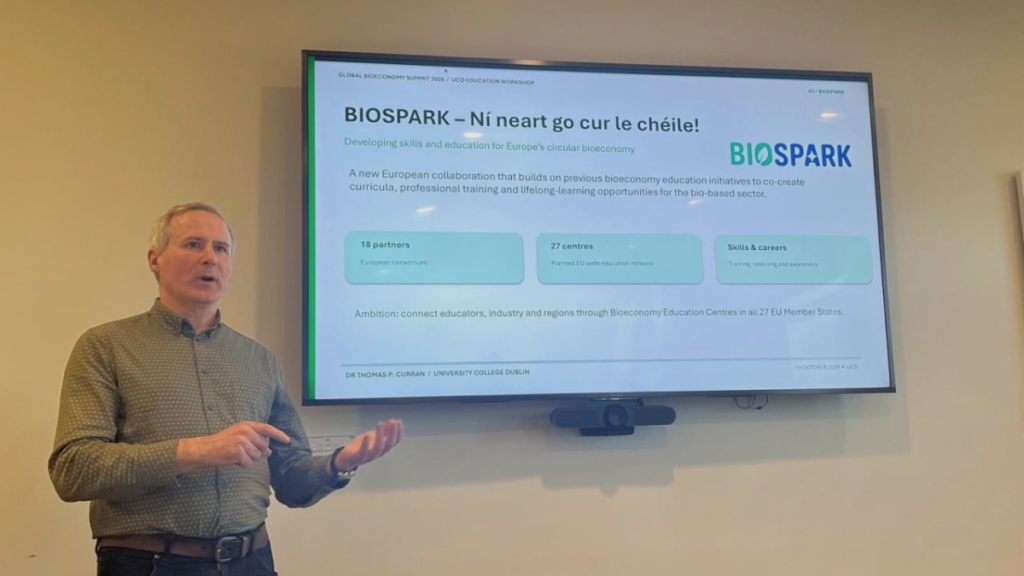
During the workshop, Dr Tom Curran (University College Dublin) presented the evolution of bioeconomy education initiatives, from the AgroCycle project to the recently launched BIOSPARK project.
BIOSPARK aims to strengthen the connection between education, industry and regions through the development of curricula, professional training opportunities and lifelong learning approaches. By supporting the development of skills and promoting awareness of the bio-based economy, the project contributes to preparing learners, educators and professionals for the transition towards a more sustainable and circular European economy.
The workshop provided an opportunity to situate BIOSPARK within the wider landscape of bioeconomy education initiatives and exchange perspectives on how existing resources, partnerships and experiences can support future developments.
A shared vision for bioeconomy education
A central conclusion of the workshop was the importance of building connections: between research and everyday life, policy and culture, educational resources and teaching practice, and schools and communities.
Contributions from Ireland and Uganda also highlighted the value of context-sensitive, place-based learning approaches. Practical recommendations included building on existing partnerships, starting with achievable initiatives and encouraging collaboration across disciplines and institutions.
Ultimately, bioeconomy education goes beyond preparing people for future employment. It also enables citizens to understand environmental challenges, participate in decision-making and help shape the bioeconomy within their own communities.
BIOSPARK welcomes these exchanges and the opportunity to contribute to a growing European and international community working to advance bioeconomy education, awareness and skills development.